

Robots Can Do the Work. Why Most Still Cannot Beat Human Costs
A robot that can perform a task and a robot an employer can afford to run are two different things. That gap, more than any demonstration, decides how physical jobs will change.
hilighter editorial team•Published •8 min read
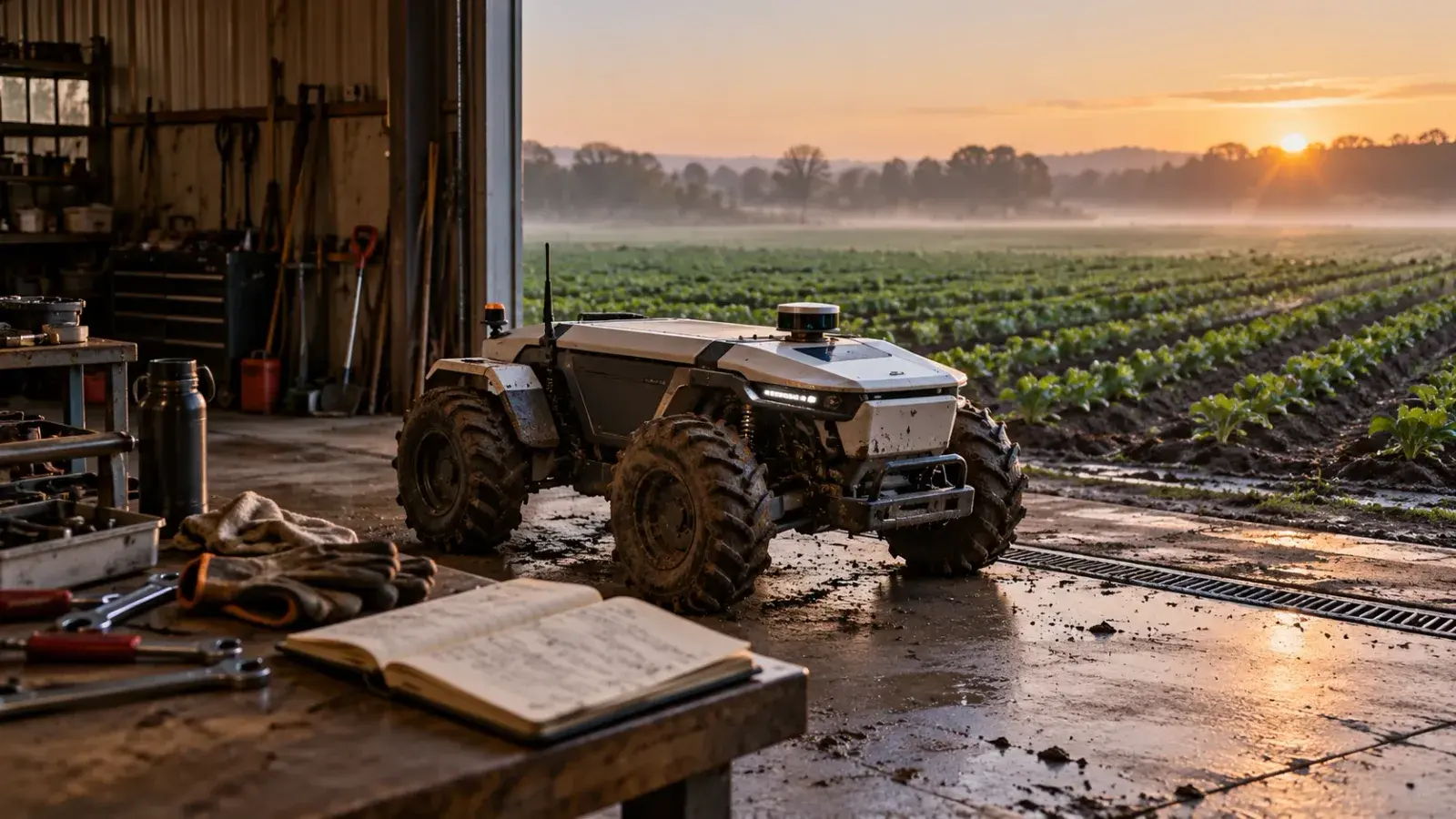
A robot can drive along a crop row, move boxes or weld metal. That does not mean it can replace the people who do those jobs at a cost an employer will accept. For a small business deciding what to automate, the difference between "can do" and "worth doing" is not a technical footnote. It is the decision.
A study published by Anthropic on 30 September 2026 puts numbers on that gap. Its authors estimate that today's robots can do 74% of physical work in some circumstances. Yet their cost model finds robots cheaper than people for just 0.3% of all work.1 The two figures answer different questions, and neither means that three quarters of physical workers are about to lose their jobs.
Our argument in this article: for physical work, the timetable of change is set by the working environment, the full operating cost and the people needed around the machine, far more than by what a robot can show in a demo.
Where robots work: the environment is part of the technology
The Anthropic researchers used the US O*NET database, around 19,000 job tasks across some 900 occupations, and rated whether a robot can perform each task in three kinds of setting:1
| Setting | Example given in the study | What it means in practice |
|---|---|---|
| Purpose-built robotic environment | A factory assembly line | The space is designed around the machine |
| Structured human work facility | A logistics warehouse | Organized, but built for people |
| Unstructured environment | A city road | Unpredictable conditions, obstacles, variation |
The 74% figure counts a task as "robot-capable" if it can be done in any of the three. That is a broad definition, and the authors chose it deliberately. The picture changes once you look at the hardest setting: according to the study, today's robots do only 2% of physical tasks in unstructured environments.1
So much of the robot capability depends on spaces that have been adapted to the robot. A large distribution center can reorganize around standard pallets, fixed routes and an in-house maintenance team. A family-owned wholesaler with mixed stock, narrow aisles and staff walking through them cannot assume that a machine shown working in the first setting will behave the same way in the second.
The cost test changes the story
Capability is where a business case starts, not where it ends. The machine has to be bought or leased and installed. The building and the workflow often have to change. Then come electricity, maintenance, downtime, and the people who handle exceptions, clear faults and remain responsible for safety.
The study's own examples show how narrow the margins can be:1
- Packers and packagers: the robots needed are estimated to cost over $2 million to buy and install, and to replace the yearly work of around 14 workers. Once capital and running costs are spread over a year, that comes to around $45,000 per worker replaced, against around $49,000 for a worker. A small margin, not proof that automation is inevitable.
- Welders: robots can carry out welding operations, but welders also position heavy parts, reach awkward angles, grind surfaces and check their work. Automating that wider mix would require robots that together cost around five times more than the human welders.
Both are US cost models for US occupations, not vendor quotes, and they do not transfer directly to a European small business with different wages, energy prices and volumes. Their value lies in the method: saving time on the most visible task is not the same as saving money on the whole job.
The study also looks ahead, with an important condition attached. Robot prices have fallen by roughly 3% a year since the 1990s; if that trend simply continued, the authors estimate it would take about 40 years for robots to become cost-competitive on 10% of work.1 That is a scenario, not a forecast. Cheaper hardware, better AI, rising wages or energy costs could all change the pace.
Cost is not the only brake either. The authors estimate that human preferences hold robots back for about a quarter of tasks, and that current regulations would not allow robots to perform 14% of physical tasks.1 In care, health and community services, people often want a person, and that preference has a value a labor-cost comparison does not capture.
What a farm trial shows about the work around the robot
Field evidence helps test the theory. In a paper published in May 2026 in the journal Precision Agriculture, researchers recorded the human labor time needed to run strip-cropping trials in southern Germany between 2022 and 2024, comparing tractors with a commercial field robot, the AgXeed AgBot 5.115T2, for soil cultivation, seeding and hoeing.2
The robot did the field work, but it still needed people: a separate mission had to be set up for each strip, the machine had to be transported by road to and from the field, its configuration had to be tweaked, and incidents required human attention. The authors concluded that, in this setting, tractors can currently run a strip-cropping system more efficiently than robots. They also modeled scenarios in which modest technical progress would bring the robot's human time requirement close to the tractor's.2
This is one research setting, with its own layout and constraints, and it does not show that farm robots fail commercially. Other work is more encouraging: a 2026 paper in Smart Agricultural Technology describes a weed-spraying robot built for about $6,000 that performed well in corn and soybean field tests in North Dakota, with an estimated (not measured) herbicide reduction of around 83%.3 But a good trial result is not yet a proven return on investment on an ordinary farm.
For workforce planning, the lesson is that autonomy moves labor more than it removes it. Work shifts from doing the task to preparing the machine, supervising it, troubleshooting stoppages and checking the results. Whether that becomes a new role, an outsourced service or extra duties for someone already stretched depends on the organization.
What managers should actually measure
For a warehouse, a service company, a nonprofit or a small manufacturer, "Which jobs are safe from robots?" is the wrong first question. A more useful one is: which specific task causes repeated cost, quality, safety or capacity problems, and could technology improve the whole process around it?
- Map the whole workflow, including the awkward bits. Record how often the task occurs, how much it varies, the physical environment and how much judgment it takes. A machine may handle the main step well and still need help with the first or last meter of the job.
- Compare full operating costs over a realistic period. Equipment, software, installation, maintenance, insurance, training, downtime, supervision and safety or compliance work. Vendor demonstrations show capability; they do not prove a net gain.
- Name the skills that would change. If a robot takes over repetitive handling, someone has to monitor its output, clear jams and adjust procedures. Do not assume these become attractive "robot supervisor" jobs on their own. Without deliberate training and staffing, they tend to be added to a role that is already full.
- Pilot before you commit. Some of the best improvements will come from ordinary process changes or digital tools rather than robotics, and some problems need no new technology at all.
The opportunity is not a humanoid robot
As robots become more capable, they may make more physical tasks automatable and create demand for integration, maintenance, field support, quality control and safety work. Those are plausible directions, not guaranteed net job gains: the studies available do not tell us how many jobs will ultimately be added or lost.
What the new evidence does give us is a better question. A job is not automated the day a robot demonstrates one of its tasks. The change begins when a real organization can run the system reliably, at a sensible cost, without lowering the quality of its work. Until then, the gap between "can do" and "worth doing" is where much of the future of physical work will be decided. The same logic applies to office work and AI agents, as we discussed in which jobs and tasks AI agents will change first.
Frequently asked questions
How much physical work can robots do today?
Anthropic's September 2026 study estimates that robots can do 74% of physical work in the US in some circumstances, counting purpose-built, structured and unstructured settings. In unstructured environments, the figure falls to 2% of physical tasks.
Are robots cheaper than human workers?
Rarely, for now. The same study finds robots cost-competitive for about 0.3% of all work, once purchase, installation and running costs are included. Narrow cases exist, such as some packing work, but margins are small.
Will robots replace physical jobs?
The evidence points to slow, uneven change driven by cost, environment, regulation and human preferences. Where robots are deployed, work tends to shift toward setup, supervision, maintenance and quality control rather than disappear.
How hilighter can help
Deciding what to automate starts with knowing what each role is made of and who has the skills to run the new way of working. hilighter helps you map skills by role, level and team, see strengths and gaps across your organization, compare people’s skills with role requirements and build personalized development paths for the people who will take on new responsibilities. Its AI Job Impact analysis gives an indicative view of how AI may change your roles. A free plan is available, and every plan is priced by the number of job roles, with unlimited employees.
Sources
- R. Legate-Yang and M. Massenkoff, Anthropic, What work can robots do?, 30 September 2026. US analysis based on O*NET task data; cost estimates are the authors’ models.
- O. Spykman, J. Lowenberg-DeBoer and M. Gandorfer, Crop robots as potential enablers of economical and biodiversity-smart small-scale farming, Precision Agriculture, vol. 27, article 80, 22 May 2026.
- A low-cost edge-based robotic platform for real-time site-specific weed spraying in row crops, Smart Agricultural Technology, 2026. Herbicide reduction estimated analytically.
Sources last reviewed: 18 October 2026.