

hilighter Logohilighter Logo
EN
Get Started
Three colleagues working together at a laptop, with illustrative cards of assessment methods, skill levels and assessment insights (not a product screenshot)

Advanced Skills Assessments

Premium module · Coming soon

There’s More Than One Way to Prove a Skill.

Managers don’t see everything employees know. Training results reveal part of the picture. Experience and feedback add more.

The Advanced Skills Assessments module is designed to bring different assessment approaches together, from self-reflection and quizzes to trainer, peer and on-the-job evaluations, to help you build a richer understanding of your people’s capabilities.

A Single Opinion Rarely Tells the Whole Story.

A manager can recognize what a person does well, but may not observe every skill in practice. A multiple-choice quiz can measure knowledge, but not necessarily the ability to apply it. And a self-assessment reveals confidence, not automatic proof of proficiency. Different capabilities deserve different kinds of evidence.

The blind spots of one-off ratings

A single review may miss what people demonstrate in other contexts.

Knowledge isn’t the same as application

A test result alone doesn’t establish practical mastery.

Inconsistent assessment methods

Without structure, different people and teams can interpret skill levels differently.

Better skills decisions begin with the right evidence, not with more forms to fill in.

Choose the Evidence That Fits the Skill

  1. 01

    For knowledge

    A quiz may show whether someone understands key concepts.

  2. 02

    For practice

    A trainer or observer may evaluate application during an exercise or real work.

  3. 03

    For experience

    A relevant project or achievement can provide contextual evidence.

  4. 04

    For reflection

    Self-assessment helps surface confidence, aspirations and perceived gaps.

  5. 05

    For progression

    A structured assessment program can combine appropriate methods over time.

More Ways to Assess What People Really Know and Can Do.

  • Self-assessments

    Employees reflect on their own skills, experience, confidence and development needs. A good start for honest development conversations, not a final proof of mastery.

  • Skills quizzes

    Structured questions check knowledge and understanding after learning, or show topics that need reinforcement. Not a substitute for workplace observation.

  • Trainer assessments

    Trainers or facilitators share relevant observations and feedback on what people showed during learning activities.

  • Peer and on-the-job evaluations

    Colleagues or observers who saw skills applied in projects and day-to-day work add relevant, fair and role-appropriate feedback.

  • Assessment programs

    Combine methods around a development moment, such as onboarding or a new role. A program is a sequence of assessments, not an automatic certification.

Not every skill needs every assessment method. The aim is relevance, not bureaucracy.

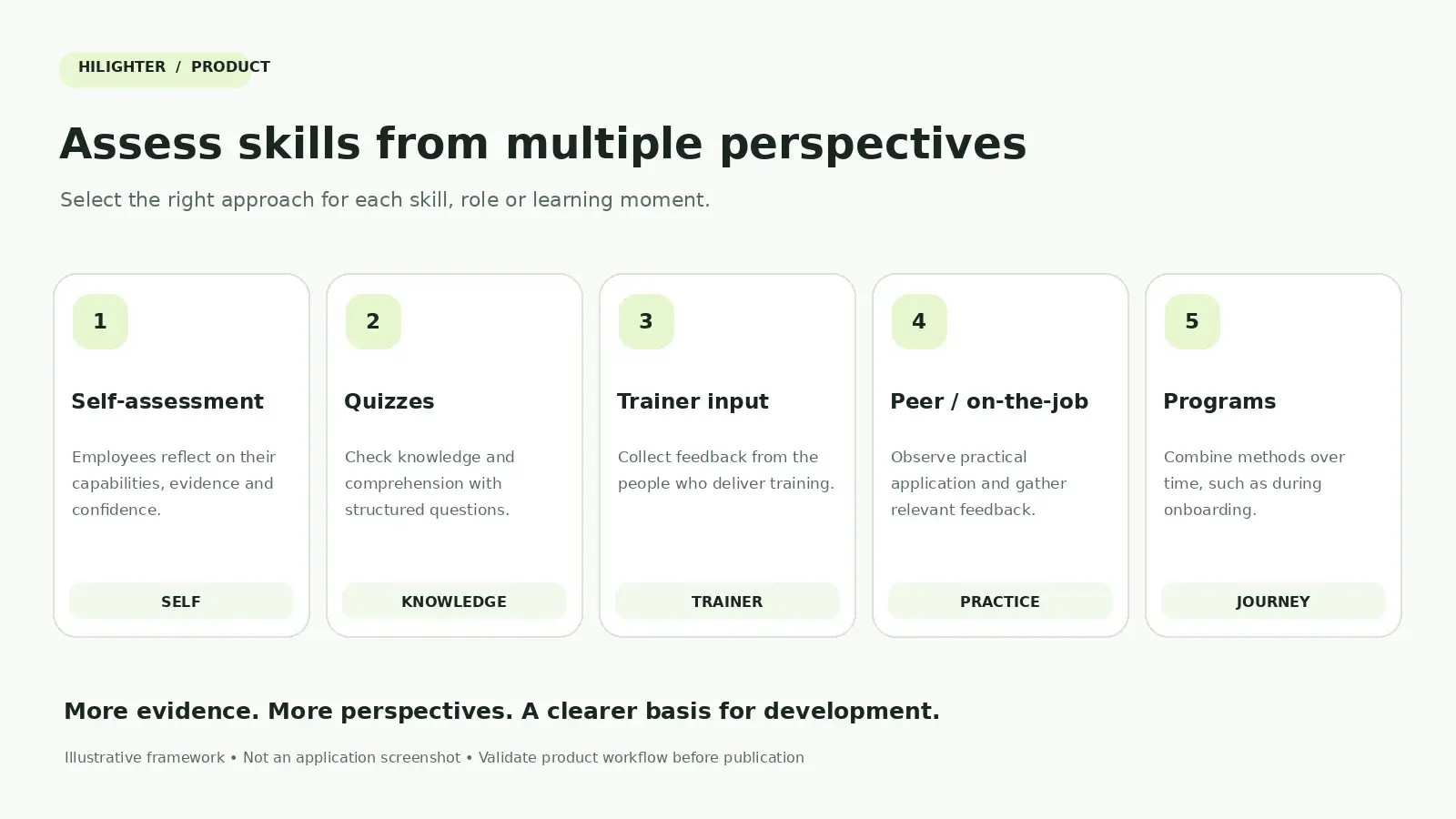
Five assessment methods: self-assessment, where employees reflect on their capabilities, evidence and confidence; quizzes, to check knowledge and comprehension with structured questions; trainer input, feedback from the people who deliver training; peer and on-the-job, to observe practical application and gather relevant feedback; programs, to combine methods over time, such as during onboarding.
Illustrative framework, not a screenshot of the application.

How an Advanced Assessment Can Work

  1. 1

    Identify the role or skills to evaluate

    Start with the capabilities needed for work or development.

  2. 2

    Choose an assessment method

    Select a quiz, self-assessment, trainer evaluation, peer input, workplace observation or program suited to that skill.

  3. 3

    Gather meaningful input

    Capture responses, observations, feedback and evidence relevant to the task.

  4. 4

    Review and interpret outcomes

    Compare results with the expected competencies and proficiency levels, with human interpretation and validation.

  5. 5

    Turn findings into action

    Use the outcomes for development, role alignment and team skills insights.

A proposed workflow: the exact screens and steps will be confirmed when the module is released.

Example: A Practical Onboarding Program

A customer operations team welcomes a new colleague. An introductory quiz checks understanding of company processes and privacy procedures. A self-assessment lets the newcomer share existing experience and confidence. A trainer observes practice on a simulated customer case. Later, a colleague or supervisor gives feedback on real-world application.

Together, these perspectives create a clearer basis for discussing strengths and what to practice next. Onboarding becomes more than a completed checklist: it becomes a practical picture of developing capabilities.

Illustrative program. It does not mean that hilighter automatically schedules, grades or combines these steps.

Benefits Beyond the Score

Employees

More ways to show capabilities, with structured feedback and a clearer development direction.

Trainers

A way to contribute observations about the skills shown during learning.

Managers

More evidence to inform evaluations than a single manager-only rating.

HR & L&D

More consistent assessment frameworks, clearer training follow-up and better-informed development decisions.

Organizations

A richer skills picture, with assessment standards, privacy and governance handled responsibly.

FAQs

How is this different from Manager Assessments?

Manager Assessments start from a documented activity or achievement: AI proposes skills and levels, and a manager validates them. Advanced Skills Assessments add dedicated assessment methods, such as self-assessments, quizzes, trainer and peer evaluations, and structured assessment programs.

Are self-assessments enough to validate a skill?

Not on their own. They offer valuable reflection but may need to be supported by another assessment or a practical demonstration.

Can a quiz verify practical proficiency?

A quiz can evaluate knowledge. Skills shown in practice may need exercises, observation, results or other suitable evidence.

Will trainer and peer feedback be included?

Trainer, peer and on-the-job evaluations are among the planned assessment methods. The exact workflow and access rules will be confirmed at release.

What is an assessment program?

A sequence of relevant evaluations around a specific objective, for example onboarding or preparing for a new responsibility.

Does AI make the final assessment decisions?

No. Assessment outcomes are reviewed and validated by people, based on appropriate evidence.

Is it included in the Free plan?

No. Advanced Skills Assessments is a Premium module in preparation, planned as an optional extension of paid plans. The Core features, including Manager Assessments, are included in every plan, including Free.

Build a Richer Picture of What Your People Can Do.

Bring the right voices, evidence and assessment methods together. Make skills evaluation more relevant, more useful and better connected to employee development.