

AI Workforce Readiness in 2026: A Practical Guide for SMEs
How to identify changing tasks, assess employee skills, and build a realistic 30-day AI readiness plan - without an enterprise HR department.
Christian Kosiek•Published •14 min read
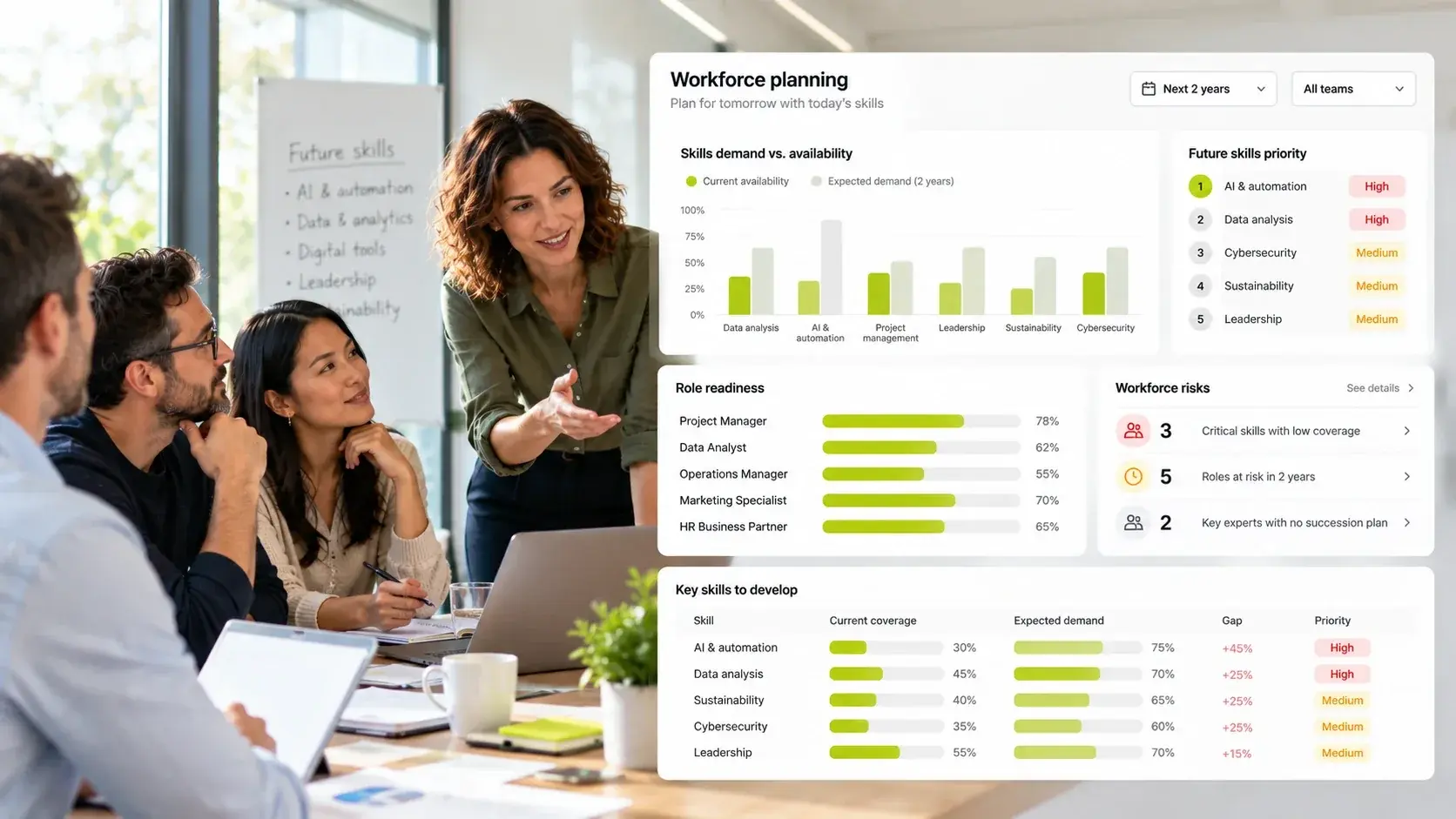
Quick answer AI workforce readiness is an organisation's ability to identify how AI may change work, understand which skills its people already have, and close the most relevant gaps safely. For SMEs, the best starting point is not an expensive transformation programme: it is a role-by-role review of tasks, current capabilities, human oversight requirements and a few measurable learning experiments.
Four findings every SME leader should understand
AI is already present at work, but adoption, job exposure and preparedness are different things.
- 30% of surveyed EU workers had used AI tools for work at least once in the previous 12 months, according to the European Commission Joint Research Centre's 2024–2025 AIM-WORK survey of 70,316 workers. This is a measure of reported worker use, not daily usage or the proportion of employers with an AI strategy.1
- 20% of EU enterprises used AI technologies in 2025, according to enterprise adoption figures discussed by the JRC. That percentage describes enterprises, not workers, and must not be treated as directly comparable to the 30% figure.2
- One in four workers globally holds an occupation with some exposure to generative AI, according to the International Labour Organization's 2025 task-level assessment. Exposure is not equivalent to redundancy: the ILO expects job transformation to be more common than outright replacement.3
- Employers surveyed by the World Economic Forum expect 39% of workers' existing skill sets to change or become outdated between 2025 and 2030. This is a forward-looking employer expectation across multiple forces of change, not an observed rate of AI-driven obsolescence.4
The operational implication is straightforward: SMEs need to know which tasks will change, which skills matter and which people need support. A count of AI-tool licences cannot answer those questions.
What is AI workforce readiness?
AI workforce readiness is the practical ability of a company and its people to use appropriate AI technologies in work processes while maintaining the skills, judgment, safeguards and accountability those processes require.
Four concepts should not be confused:
| Concept | What it means | What it does not mean |
|---|---|---|
| AI adoption | A person or organisation uses AI in some form | Employees consistently use it well, safely or productively |
| AI exposure | Some tasks within an occupation could be affected by AI capabilities | The occupation will disappear |
| Skills gap | A mismatch between a role's required capabilities and someone's demonstrated capabilities | An employee is underperforming or replaceable |
| Workforce readiness | Skills, processes, oversight and learning are sufficiently developed for a defined use case | Everyone must become an AI engineer |
This distinction matters particularly for smaller organisations. The OECD finds that AI adoption remains uneven and that SMEs face barriers including skills shortages, costs and infrastructure constraints. It also stresses the importance of foundational skills, digital literacy and complementary abilities such as critical thinking and collaboration.5
Why start with tasks rather than job titles?
A job title conceals very different types of work. A customer support representative might spend time answering routine questions, investigating unusual complaints, calming frustrated customers and deciding when to escalate a case. An AI assistant might help draft the first kind of response; the other tasks still require context, care, accountability and sometimes specialist judgment.
A useful question is therefore not "Will AI replace our customer support role?" It is "Which parts of this role may change, what evidence would show AI is useful, and what skills are required to use it responsibly?"
The ILO's assessment evaluates thousands of tasks rather than assuming a uniform effect on every job. The OECD likewise distinguishes exposure from automation risk.35
Five questions to ask about any task
- Repetition: Is the task repeated frequently with reasonably consistent inputs?
- Information: Does it involve summarising, drafting, classifying or finding information that approved tools can process?
- Judgment: Which decisions require professional expertise, legal responsibility or human approval?
- Data sensitivity: Does the task use personal, confidential, contractual or commercially sensitive information?
- Quality control: How will a person verify accuracy, fairness, completeness and the outcome for customers or colleagues?
A task may be technically suitable for AI but still inappropriate for a pilot if its data, reliability or governance risks are not controlled.
A five-step AI workforce readiness assessment for SMEs
Step 1 - Select a small number of business-critical roles
Begin with three roles, not the entire organisation. Choose roles with recurring knowledge-work tasks, measurable outputs and willing managers. For example: customer support, sales operations and finance administration.
For each role, document its purpose, five to ten recurring tasks, and the outcomes the team is accountable for. Include the manager and affected employees in the discussion. Avoid relying only on job descriptions written years ago.
Output: A short role-and-task inventory.
Step 2 - Identify realistic AI-assisted workflows
For each task, decide whether AI could assist with drafting, retrieval, summarisation, analysis or workflow preparation. Write down where a person must review the result and who remains accountable.
Separate possible support from approved implementation. Do not upload real customer, employee or confidential information into an unapproved public AI tool to test an idea.
Output: A task map labelled potentially assistable, human-led or not suitable for the current pilot, with reasons.
Step 3 - Define the skills needed for the changed task
Do not replace every job description with a generic requirement for "prompt engineering." Define capabilities employees can demonstrate, such as:
- Understanding the task and its quality standards.
- Choosing whether AI is appropriate and using approved tools.
- Writing a clear instruction with sufficient context.
- Checking factual accuracy and identifying plausible-sounding errors.
- Protecting sensitive information and documenting when human escalation is required.
- Communicating clearly with customers, colleagues and managers.
The OECD emphasises that AI literacy works alongside foundational, ICT and complementary human skills.5
Output: A short, observable skills list per priority role.
Step 4 - Compare role requirements with demonstrated capabilities
Use a simple scale and concrete evidence, not an unexplained AI-generated readiness percentage.
| Level | Observable description |
|---|---|
| 0 - Not yet demonstrated | No relevant evidence is available |
| 1 - Developing | Can complete a basic task with guidance |
| 2 - Independent | Can perform the defined task reliably without routine assistance |
| 3 - Can guide others | Can manage complex cases, check others' work and coach colleagues |
For each skill, record the target level, the current evidenced level and the support required. The scale is an illustrative management tool, not a validated psychometric instrument. Use employee self-assessment, manager review and work samples; offer a way to challenge inaccurate assessments.
Output: A role-based skills-gap matrix with agreed development priorities.
Step 5 - Run a limited pilot and review the evidence
Choose one or two low-risk workflows. Train participating employees, document acceptable tool use and test performance on real business outcomes using appropriate safeguards.
Possible measures include:
- First-pass accuracy or quality, checked by a human.
- Rework or correction rate.
- Time spent on the task, compared with a meaningful baseline.
- Employee confidence and ability to explain the result.
- Errors, escalations and privacy incidents.
Review after two to four weeks. A pilot is successful only if the process genuinely improves while preserving quality, accountability and acceptable working conditions.
Output: A decision to scale, revise or stop the use case, together with an updated skills plan.
Ten common SME roles: illustrative task-to-skill examples
The following examples are editorial scenarios, not measured AI exposure scores, forecasts of job losses or findings from a sample of ten companies. The appropriateness of any AI use depends on the sector, specific job design, available tools and risk controls.
| Role | Task that AI might support | Human responsibility that remains essential | Skills to develop or reinforce |
|---|---|---|---|
| Customer support | Draft responses to common questions from approved knowledge sources | Handle exceptions, empathy, complaints and customer commitments | Source verification, escalation judgment, clear communication |
| Sales / account management | Summarise approved CRM notes and prepare meeting outlines | Relationship-building, negotiation, commitments and deal decisions | CRM data quality, fact-checking, consultative selling |
| Marketing / communications | Generate first drafts, audience variations and campaign ideas | Brand positioning, approvals, accuracy and campaign judgment | Brief writing, editorial review, audience understanding |
| Finance / accounting | Categorise routine expenses or flag anomalies in controlled systems | Financial controls, reconciliation, statutory judgments and sign-off | Data interpretation, exception handling, audit trails |
| HR / people operations | Draft role descriptions or assemble training materials | Fair assessment, employee relations, privacy-sensitive decisions | Competency definition, bias awareness, interpersonal judgment |
| Administrative support | Summarise meetings and structure non-sensitive documents | Verify action items, deadlines, permissions and confidential handling | Document validation, workflow coordination, information security |
| Procurement | Compare supplier specifications and draft requests for quotation | Supplier due diligence, commercial decisions and contractual commitments | Evidence comparison, risk identification, negotiation |
| Operations / logistics planning | Suggest schedules or summarise operational patterns | Safety, real-world constraints, staff consultation and exception management | Scenario evaluation, domain expertise, operational judgment |
| Team supervisor | Draft routine updates or summarise agreed performance indicators | Coaching, conflict resolution, staffing and responsibility for decisions | Feedback, fairness, interpreting metrics and AI literacy |
| IT / digital operations | Help document code, troubleshoot common issues or draft support steps | Security, architecture, access controls and production approval | Code review, threat awareness, testing and tool governance |
How to use this table: Choose one role, replace the generic task with your actual workflow, define an accountable manager and identify the evidence needed before and after a pilot. Avoid using the table to rank employees or label roles as "safe" or "at risk."
Worked example: a small customer support team
Hypothetical scenario: an SME with a customer support team wants to use an approved AI assistant to help draft routine replies. The values below are examples, not observed hilighter customer data.
The team chooses three skills and agrees to use the 0–3 demonstration scale:
| Required capability | Example current level | Pilot target | Practical development action |
|---|---|---|---|
| Verify answers against approved product information | 1 | 2 | Practice source checking on 10 anonymised example cases |
| Recognise when an issue requires human escalation | 2 | 2 | Maintain skill; review edge cases collectively |
| Draft clear responses and review AI suggestions | 1 | 2 | Guided practice, peer review and manager feedback |
The initial skills gaps are in source verification and response review, not in the entire customer support occupation. A short pilot might start with anonymised FAQs, require approval before sending any response and measure correction rates.
At the end of the pilot, the manager can ask: Did response quality improve? Were customers served appropriately? Did employees demonstrate the target skills? Were privacy rules respected? Should the team continue, adapt or abandon the workflow?
This produces an actionable development decision rather than an arbitrary "AI readiness score."
A practical 30-day AI readiness plan
| Period | Action | Deliverable | Owner |
|---|---|---|---|
| Days 1–7 | Select three roles; list actual tasks; agree approved tools and safeguards | Role-and-task inventory | Business owner + team managers |
| Days 8–14 | Identify potential AI-assisted tasks and required skills; collect initial evidence | Skills requirements and baseline | Managers + participating employees |
| Days 15–21 | Provide short training; run a supervised low-risk pilot | Pilot log and skill-development activities | Process owner |
| Days 22–30 | Check quality, time, corrections and employee feedback; decide what to change | Next-quarter skills actions and pilot decision | Management team |
A realistic success criterion: At least one priority workflow has been evaluated with actual evidence, and the company knows which skills it must strengthen next. A 30-day pilot does not make an organisation universally "AI-ready."
How should an SME prioritise skills gaps?
Not every missing capability deserves immediate training. Use four practical tests:
- Business relevance: Is the skill needed for an important, recurring task?
- Risk and oversight: Could an error affect customers, employees, finances, safety or compliance?
- Current gap: Is there credible evidence that people cannot yet perform at the required level?
- Feasibility: Can training and supervised practice close the gap in a reasonable period?
Prioritise skills that combine high business relevance with a demonstrated gap and manageable training effort. Address critical safeguards before launching AI-enabled workflows. Treat the result as a management judgment, not a scientifically validated numeric ranking.
Five mistakes to avoid
1. Counting AI licences as evidence of readiness. Tool access says little about employee capability or the quality of outcomes.
2. Treating job exposure as a replacement forecast. Exposure indicates that some tasks may change; it does not establish the fate of a job.35
3. Training everyone on identical prompts. Different roles require different domain knowledge, review standards and escalation practices.
4. Using opaque AI-generated employee scores. Skills assessments should be grounded in clear requirements, observed evidence and human review. Avoid making consequential employment decisions based on an unexplained score.
5. Measuring speed but ignoring quality and people. A faster draft that creates more corrections, unsafe disclosures or employee stress is not a successful transformation.
How hilighter can help
hilighter is an AI-powered skills management platform developed by SkillsBoard SAS. Its current skills-management workflows can help organisations define roles, map associated skills, document employee capabilities, collect manager assessments and identify development priorities.
For a small organisation, the practical starting point is to establish the skills baseline before investing in advanced workforce transformation. hilighter's Free Skills Matrix offer provides a way to begin with up to three job roles and unlimited employees, subject to the current plan terms. Organisations can then explore Skills Gap Analysis or read more about AI Workforce Readiness.
Product transparency: This guide does not claim that hilighter currently automates all AI exposure analysis or delivers a finished automated AI Readiness assessment inside the application. Feature availability should be checked against the live product at publication.
Frequently asked questions
What is the difference between AI readiness and AI adoption?
AI adoption means that AI is being used. AI readiness means that people, tasks, controls and skills are prepared for specific AI-enabled workflows. A company can have widespread experimentation but poor readiness.
Does higher AI exposure mean a job will disappear?
No. Occupational exposure describes how much of a job's task content could be affected by AI. Actual employment outcomes depend on task design, human judgment, business choices and many other factors.35
How can a small company assess AI readiness without an HR department?
Start with three important roles, interview their managers and employees, record recurring tasks, define observable required skills, and run one supervised pilot. Use a small evidence-based skills matrix rather than a large survey or unsupported numerical score.
Which skills should employees learn first?
Start with task-specific digital literacy, information verification, safe handling of data, sound judgment and clear communication. More advanced AI or programming skills are needed only when they fit the actual role and use case.5
Can AI perform the skills assessment itself?
AI can assist with organising descriptions and identifying possible skill requirements, but assessments of actual people should rely on appropriate evidence, transparent criteria and accountable human review. Do not infer an individual's capabilities simply from a job title.
How long does an AI readiness assessment take?
An SME can complete a limited initial role-and-task review and pilot planning in a few weeks. The 30-day plan in this guide is a suggested starting process, not a guarantee of organisational readiness or measurable productivity gains.
Methodology and limitations
Type of publication: An evidence-based editorial synthesis and a practical assessment framework prepared for hilighter / SkillsBoard SAS; not original field research, a validated occupational-exposure model, a representative business survey or an independent certification of AI readiness.
Evidence base: Publications from the European Commission's Joint Research Centre, the International Labour Organization, the OECD and the World Economic Forum, published in 2025–2026 and listed below. Their datasets, populations and definitions vary; percentages are not combined or interpreted as if they measured the same phenomenon.
Original editorial contribution: A qualitative five-step implementation framework, ten illustrative role scenarios, an example skills matrix and a suggested 30-day action plan. These are practical examples, not empirically validated intervention results or forecasts for specific employers.
Limitations: Effects differ by organisation, industry, tasks, workers, data quality, available AI tools and applicable rules. Capability requirements will change. Sensitive and high-impact uses require specific evaluation, employee involvement and appropriate professional or legal review. This guide must not be used to make automated employment decisions.
Sources reviewed: 23 October 2026. Publication date reflects the site release of this English guide.
Sources
- European Commission, Joint Research Centre, AI and Skills, JRC148616, released 15 October 2026. Describes EU worker AI use in 2024–2025 and the relationship between occupational exposure and adoption. Supporting survey explanation: AI and the changing nature of work.
- European Commission, Joint Research Centre, AI adoption more than doubles in almost every EU strategic sector, 14 October 2026. Distinguishes 18% adoption in EU strategic sectors from 20% across EU enterprises in 2025.
- International Labour Organization, Generative AI and jobs: A 2025 update, published 20 May 2025. Task-level occupational exposure and the distinction between transformation and replacement.
- World Economic Forum, The Future of Jobs Report 2025, published 7 January 2025. Employer expectations for skills and work through 2030.
- OECD, Skills in the AI age, OECD Artificial Intelligence Papers, No. 60, published 8 July 2026. AI adoption, exposure, and the importance of foundational, digital and complementary skills.
Sources last reviewed: 23 October 2026. Editorial guide by hilighter / SkillsBoard SAS. Byline on this site: Christian Kosiek.