

AI Agents Are Changing the Workplace: Which Jobs and Tasks Will Change First?
AI is moving from drafting work to doing it. The first tasks to change are not simply the easiest ones. They are the ones a system can reach, follow, check, and get wrong without serious harm.
hilighter editorial team•Published •15 min read
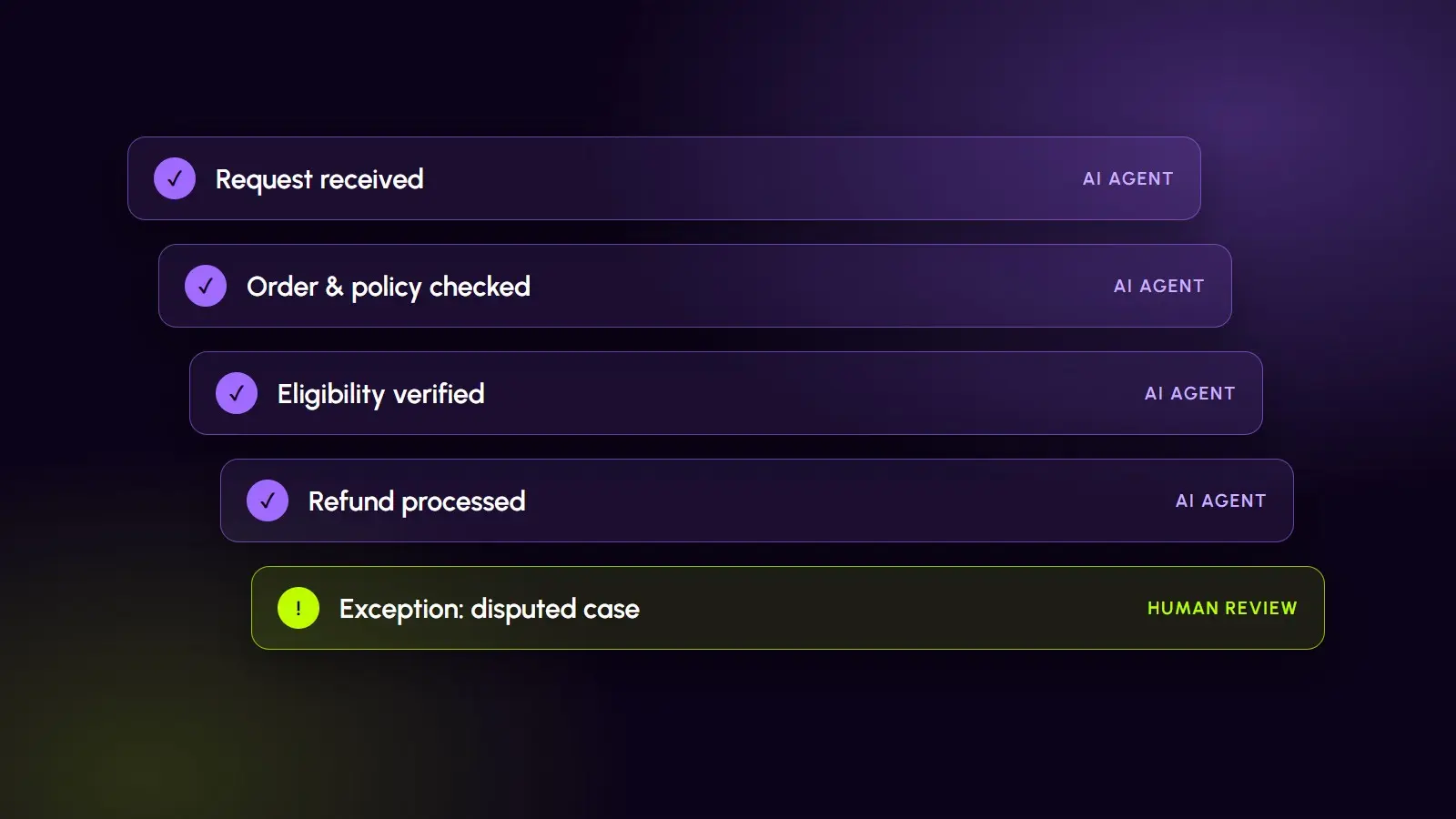
A customer writes in to ask for a refund. Until recently, an AI tool could draft the reply, and an employee did everything else: checking the order, reading the policy, issuing the refund, updating the record. An AI agent can now do most of those steps itself and pass on only the cases that don't fit the rules.
That is the real shift behind the current wave of "agentic AI". The question is no longer how fast an employee can do a task with AI help, but which tasks the employee still does at all.
This article argues three things. First, agents will change tasks long before they remove job titles, and those task changes can quietly turn a job into something different. Second, the tasks that change first are predictable if you test them against four conditions, which we set out below. Third, most organizations can't yet run that test, because they don't know in enough detail which tasks and skills make up each role.
From AI assistants to AI agents: what actually changes
An AI assistant responds to a request: you ask for a draft, you get a draft. An AI agent works toward a goal. Given access to the right systems and permissions, it can look up information, take actions in business applications, check the result and decide on the next step, with a person approving or reviewing at defined points.
The refund example shows the difference step by step:
| Step | With an AI assistant | With an AI agent |
|---|---|---|
| Read the request | Employee | Agent |
| Check the order and refund policy | Employee | Agent |
| Decide whether the refund is eligible | Employee | Agent, within set limits |
| Issue the refund and update the record | Employee | Agent, or employee approves |
| Handle unusual or disputed cases | Employee | Employee |
| Write the reply | AI drafts, employee edits | Agent drafts or sends |
The time saved is the visible part. The less visible part is a change of role: the employee no longer processes the standard cases but supervises them and resolves the rest.
Adoption is moving quickly, at least in the ecosystems of the largest vendors. Microsoft reports that the number of active agents in its Microsoft 365 ecosystem grew 15 times year over year, and 18 times in large enterprises, based on its own platform data from March 2025 to March 2026.1 Anthropic's June 2026 Economic Index report finds that usage of its Claude models increasingly consists of long-running agentic tasks, with its coding agent working markedly more autonomously than its chat interface.2 Both are vendor figures from their own platforms, not measures of the whole economy, but they point in the same direction.
Which tasks change first? A four-part test
"Repetitive" is not a good enough predictor. Plenty of repetitive work is hard to hand over, and some complex work is surprisingly easy to delegate. In our reading of the evidence, a task is ready for an agent when it meets four conditions at once:
| Condition | Question to ask | Example that passes | Example that fails |
|---|---|---|---|
| Reachable | Does the work happen in systems the agent can access, with permission? | Updating a ticket in a help-desk tool | A decision made in a hallway conversation |
| Rule-bound | Is there a documented policy or procedure? | Applying a refund policy | Deciding whether to keep a key customer happy despite the policy |
| Checkable | Can a person verify the result quickly? | Matching an invoice to a purchase order | Judging whether a strategy is sound |
| Recoverable | Is a mistake cheap and reversible? | A misfiled document | A wrongly rejected job applicant |
Tasks that pass all four tend to change first. Tasks that fail the last condition usually keep a person in the decision even when the technology could do more, because the cost of an error is too high. This is an editorial framework, not a validated model, but it explains most of the early examples below better than a list of "exposed occupations" does.
The test also shows why job titles are a poor unit of analysis. Two people called "office coordinator" can have completely different task mixes, and therefore very different exposure.
Seven job families where the change is starting
The examples below are the families where the four conditions are met most often today. None of them is disappearing. In each, part of the daily work is moving to agents, and the part that remains is changing in character.
Customer service: the job becomes managing exceptions
Order status checks, standard cancellations, account updates, ticket routing and follow-up messages all pass the four-part test. An online retailer facing a wave of delivery-delay messages could let an agent read the shipment data, apply the compensation policy and close the routine cases, leaving complaints, disputes and vulnerable customers to people.
Speed is not the same as satisfaction, though. A randomized field experiment in Alibaba's customer service, published as a preprint in May 2026, found that agentic AI shortened chats but substantially lowered customer ratings for the conversations it handled. Human intervention protected quality for technical escalations but helped less when customers were upset.6 The study has not yet been peer reviewed, but the lesson is useful: the tasks that fail the "recoverable" test include emotional ones.
What changes for the role: fewer lookups, more judgment, and responsibility for checking what the agent did.
Administrative and office roles: from processing to coordination
Scheduling, meeting follow-ups, expense claims, routine documents and record updates are multi-step digital workflows, which is exactly what agents are designed for. The International Labour Organization's 2025 update on generative AI and jobs again found clerical occupations to be the most exposed.4
Organizing an internal training session is a good illustration. An agent can propose dates, send invitations, track confirmations and flag clashes. The coordinator still decides which clash matters, who must not be left out and what the session is really for.
What changes for the role: less copying between systems, more coordination, exception handling and responsibility for data quality.
Software development: from writing code to directing and reviewing it
Software is where agents are furthest along. Coding agents can write standard components, generate tests, fix certain bugs, update documentation and restructure code. Anthropic's data shows its coding agent operating with noticeably more autonomy than chat-based use.2
For an experienced developer, a routine feature may now mean writing a precise specification, letting an agent produce a first version, then reviewing it for security, performance and fit with the rest of the system. Architecture, ambiguous requirements and long-term maintenance remain human work.
The harder question concerns junior developers. Routine coding tickets were how many of them learned the codebase. If agents absorb those tickets, teams need another way to build that experience (see the section on entry-level jobs below).
What changes for the role: more specification, review and system design; less typing of standard code.
Finance and accounting: automate the matching, keep the accountability
Finance runs on structured documents and clear rules, so agents extend existing automation naturally: reading and coding invoices, matching them to purchase orders and goods receipts, flagging discrepancies, preparing recurring reports and first drafts of variance explanations.
The "recoverable" condition sets the limit. Payments, approvals and anything touching fraud or regulatory reporting need a named person who is accountable. An agent can prepare a reconciliation; it can't sign it off.
What changes for the role: less data collection, more analysis, controls and decision support.
Marketing and sales operations: production gets cheaper, judgment does not
Market research summaries, campaign variants, audience segments, performance reports and sales follow-up drafts are increasingly agent work. A small team can ask an agent to analyze a campaign, find the weak segments and prepare changes for approval.
The catch is that if every competitor can produce content in volume, volume stops being an advantage. Positioning, customer insight and editorial judgment become the scarce part of the job.
What changes for the role: from producing deliverables to setting direction, choosing what to publish and reading the results.
Human resources: useful for administration, regulated for decisions
HR has plenty of agent-ready work: drafting job descriptions, scheduling interviews, answering routine policy questions, preparing onboarding across IT, facilities and managers, and cleaning up records.
Decisions about people are different, and in the EU this is not only a matter of good practice:
- The EU AI Act classifies AI systems intended for recruitment and selection (including targeted job ads, filtering applications and evaluating candidates) and for decisions on promotion, termination, task allocation and performance monitoring as high-risk (Annex III, point 4).9
- After the 2026 "Digital Omnibus" amendments, the high-risk obligations for these systems are scheduled to apply from 2 December 2027, instead of August 2026.10
- Employers that use a high-risk AI system at work must inform workers' representatives and the affected workers before putting it into use (Article 26(7)).9
- Using AI to infer emotions in the workplace is prohibited, except for medical or safety reasons (Article 5(1)(f)), and has been since 2 February 2025.9
- Under the GDPR, people have the right not to be subject to a decision based solely on automated processing that has legal or similarly significant effects on them, with limited exceptions (Article 22).11
What changes for the role: less administration, more time for development, workforce planning and the people decisions that must stay human.
Nonprofits and social organizations: capacity gains, unevenly shared
Small organizations spend a large share of their time on grant applications, project reporting, volunteer scheduling and donor communications. Agents could free up that time for programs and beneficiaries. The barrier is access: funding, technical support, digital skills and data protection are harder to secure for a five-person charity than for a corporate department.
What changes for the role: more capacity for the mission, if the organization can afford the set-up and oversight.
At a glance: tasks change before job titles
| Job family | Tasks most likely to change early | Human responsibilities that stay central |
|---|---|---|
| Customer service | Status checks, standard requests, routing | Complaints, emotional situations, relationships |
| Administration | Scheduling, data transfers, routine documents | Coordination, discretion, exceptions |
| Software development | Standard code, tests, documentation | Architecture, security, review |
| Finance | Invoice matching, reconciliations, report preparation | Controls, approval, accountability |
| Marketing and sales | Drafts, research, campaign operations | Strategy, positioning, brand judgment |
| Human resources | Scheduling, documentation, routine questions | Hiring and career decisions, employee relations |
| Nonprofits | Reporting, grant drafts, coordination | Beneficiaries, partners, mission decisions |
This table is an editorial assessment of plausible early changes, not a statistical ranking of occupations or a forecast of job losses.
The ILO puts the scale in perspective: about one in four workers worldwide is in an occupation with some exposure to generative AI, and the most likely outcome for most jobs is transformation rather than replacement.4 Exposure tells you where change will happen, not how many jobs will remain.
Why agents won't replace whole teams overnight
The technology is improving fast, but reliability is still the bottleneck. On the OSWorld benchmark, where agents carry out tasks on a real computer, the best systems reached 66.3% task success in 2025, according to Stanford's 2026 AI Index. That is close to the human baseline of 72.4%, but it still means failing about one attempt in three.3 Benchmarks don't translate directly into workplace performance, and a simple calculation shows why multi-step work is hard: a system that gets each step right 95% of the time completes a ten-step workflow without any error only about 60% of the time (0.95¹⁰ ≈ 0.60). That is why checkpoints and human review matter more as workflows get longer.
Four other constraints slow deployment:
- Access: agents only help where data and applications can be connected safely, and many organizations aren't there yet.
- Security: an agent that can read and change systems can also leak data or take unintended actions. Anthropic, for example, recommends setting each tool to "always allow", "needs approval" or "blocked", and reviewing an agent's plan rather than each step; it states plainly that defenses against prompt injection are not a guarantee.7
- Accountability: the organization remains responsible for the outcome, whoever or whatever performed the task.
- Readiness: in Microsoft's 2026 survey of 20,000 AI users in ten countries, only 19% belonged to the group where both organizational capability and individual readiness were high.1
For most employers, the limiting factor isn't the model. It is knowing which work to hand over, who checks it, and what people will do instead.
The entry-level question
The tasks that agents take on first are often the ones that used to train newcomers: preliminary research, first drafts, routine requests, basic analysis, checking other people's work. They had a business purpose, but they also taught judgment.
Automating them without a plan risks a hollow middle: fewer juniors learning the craft today, fewer experienced people tomorrow. ILO research published in September 2026 adds a relevant detail: across more than 1,000 local labor markets in 69 countries, prime-age workers benefited more from new technologies than younger or older workers.5
The opposite outcome is possible too. With good supervision, juniors can use agents to take on more advanced work earlier. The difference lies in deliberate design: for example, having new employees review and correct agent output as part of their training, rather than leaving that review to senior staff only.
The skills that gain value alongside agents
As people move from doing every step to directing and checking agents, some capabilities become more valuable:
- Judgment: knowing when an output is wrong, and when a case needs a person.
- Process understanding: knowing how the steps fit together and where the risks are.
- AI literacy: knowing what to delegate and where the limits are. Under the EU AI Act, as amended in 2026, providers and deployers of AI systems must take measures to support the AI literacy of the staff who use them (Article 4).9, 10
- Communication and relationships: negotiation, empathy and stakeholder management make up a larger share of the remaining work.
- Learning agility: employers expect 39% of workers' core skills to change by 2030, according to the World Economic Forum.8
One finding deserves attention because it runs against intuition. In the ILO's 2026 analysis, local demand for cognitive, basic computer, writing, project and process management, and people management skills was associated with stronger employment gains from new technologies, while higher demand for specialist machine-learning and AI skills was, on average, linked to weaker employment responses.5 For most organizations, broad workforce skills matter more than hiring a few AI specialists.
What to do now: a five-step plan
You don't need a transformation program to prepare. You need a clear view of the work.
- List tasks, not job titles. For one team, write down what people actually spend their week on. Two people with the same title often do very different work.
- Score each task against the four conditions. Reachable, rule-bound, checkable, recoverable. The tasks that pass all four are your candidates.
- Decide what should stay human. Some tasks could be automated but shouldn't be, because of customer impact, data sensitivity, fairness or legal requirements, especially in HR.
- Map the skills the new version of the role needs. Supervising an agent, handling exceptions and coaching others are skills. Find out who already has them and who needs support.
- Pilot one contained workflow. Measure accuracy, quality, the cost of supervision and how employees experience it, not just time saved.
The aim is not to automate as much as possible. It is to decide how work should be done, then help people grow into the roles that result.
The bottom line
AI agents are starting to change the composition of work: fewer steps done by hand, more supervision, more exceptions and more judgment. Some roles will shrink, others will grow, and new responsibilities will appear around directing and governing agents. There is no credible basis for predicting that every office job will disappear, or that productivity will rise automatically.
The biggest change may not be lost job titles at all. It may be that the same job titles describe very different jobs, and organizations that know their people's tasks and skills will be the ones able to manage that shift.
Frequently asked questions
What is an AI agent in the workplace?
An AI agent is a system that plans and carries out a sequence of steps toward a goal, using connected applications and company information. Unlike a chatbot that only answers, an agent can take actions, such as updating a record or processing a request, check the result and adjust, usually within limits and approvals set by the organization.
Which jobs will AI agents affect first?
Customer service, administrative and clerical work, software development, finance, marketing operations and HR administration are among the first. Within each, the tasks that change first are digital, rule-based, easy to check and low-risk if something goes wrong.
Will AI agents replace employees?
Some tasks will be fully automated, and some roles may shrink. Current evidence, including the ILO's global analysis, points mainly to jobs being transformed rather than replaced, but the outcome depends on how each organization redesigns work.
What skills do employees need to work with AI agents?
Judgment and quality control, process understanding, AI literacy, communication and the ability to keep learning. Broad workforce skills appear to matter more than specialist AI expertise for most organizations.
Are AI agents used in HR regulated in the EU?
Yes. AI systems used for recruitment, promotion, termination, task allocation or performance monitoring are high-risk under the EU AI Act (Annex III, point 4), with obligations scheduled to apply from 2 December 2027 after the 2026 amendments. GDPR rules on automated decision-making (Article 22) already apply.
How hilighter can help
Preparing for AI agents starts with knowing your people's skills and how they relate to the work. hilighter is an AI-powered platform to map, measure and grow skills: you can organize skills by role, level and team, evaluate what each training or hands-on experience is worth, reveal strengths and close skill gaps, and guide each employee with a personalized learning path. That gives you the task-and-skill picture needed to decide what to automate, what to keep human and who needs support. The Basic plan is free.
Sources
- Microsoft WorkLab, 2026 Work Trend Index: "Agents, human agency, and the opportunity for every organization", 5 May 2026. Survey of 20,000 AI users in 10 countries; agent growth based on Microsoft platform data.
- Anthropic, Anthropic Economic Index report: Cadences, 26 June 2026.
- Stanford Institute for Human-Centered AI, The 2026 AI Index Report, 2026.
- International Labour Organization, Generative AI and jobs: A 2025 update, 20 May 2025.
- I. Delaporte and V. Escudero, International Labour Organization, From exposure to opportunity: Why skills shape the employment effects of new technologies, 29 September 2026.
- Y. Wang, C. Zhu, T. Feng, L. X. Lu and B. Jia, Agentic AI and Human-in-the-Loop Interventions: Field Experimental Evidence from Alibaba's Customer Service Operations, arXiv preprint, May 2026 (not peer reviewed).
- Anthropic, Trustworthy agents in practice, 9 April 2026.
- World Economic Forum, The Future of Jobs Report 2025, January 2025.
- Regulation (EU) 2024/1689 (Artificial Intelligence Act), Official Journal of the European Union, Articles 4, 5(1)(f), 26(7) and Annex III, point 4.
- Regulation (EU) 2026/1744 amending Regulation (EU) 2024/1689 ("Digital Omnibus on AI"), Official Journal of the European Union, 24 July 2026.
- Regulation (EU) 2016/679 (General Data Protection Regulation), Article 22.
Sources and regulatory references last reviewed: 16 October 2026.