

California Has AI Jobs. Who Gets the Opportunity?
On 19 November 2026, PPIC wrote that current evidence does not support widespread AI job displacement in California. Access is a separate question.
Christian Kosiek•Published •19 min read
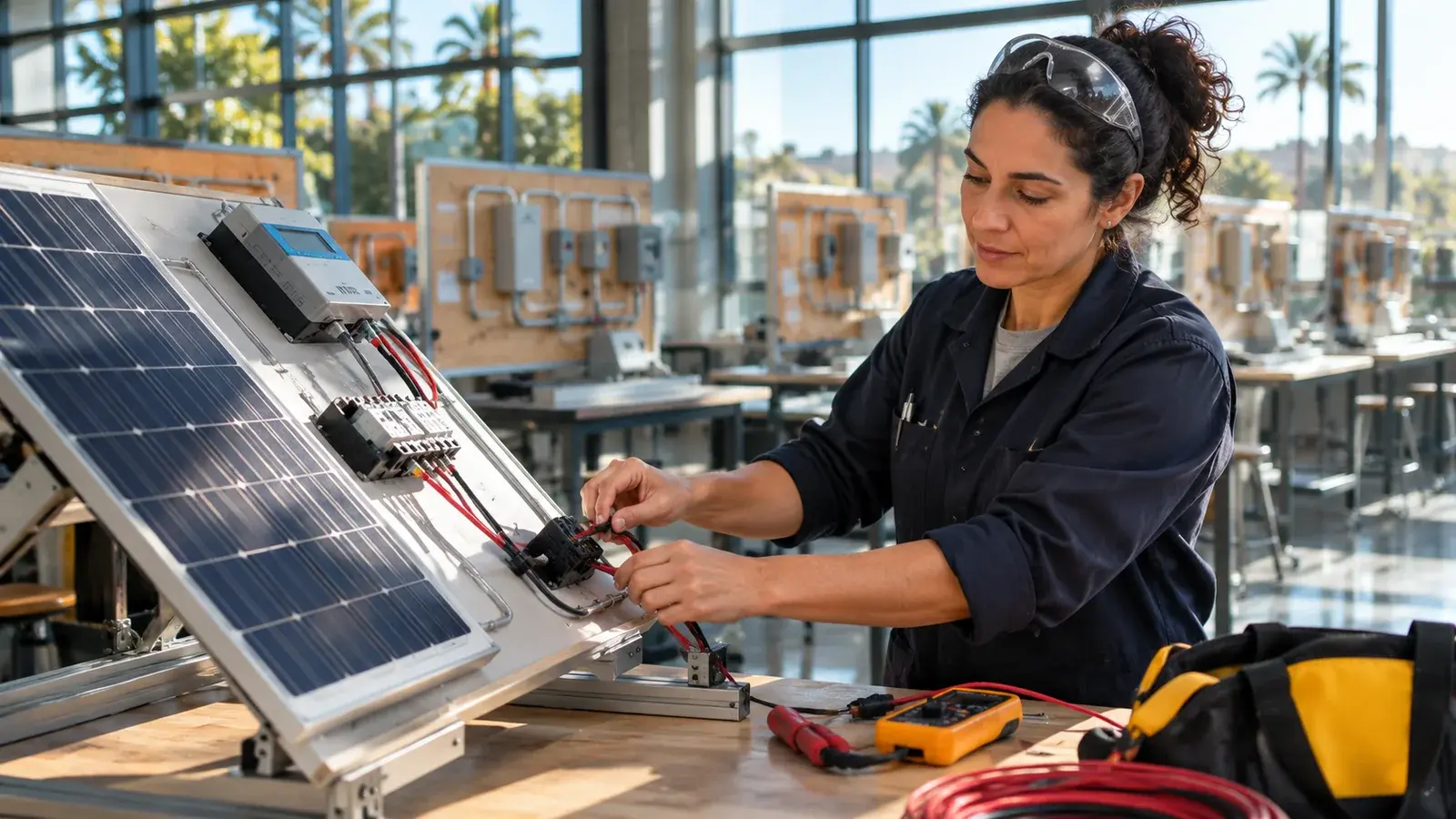
A state can host the companies that build AI and still leave most workers outside the new jobs, the tools and the practice that would let them use either. That tension is the point of a Public Policy Institute of California blog post published on 19 November 2026. PPIC's publication index names Sarah Bohn, Julien Lafortune and Daniel Payares-Montoya as the authors. The post is the 12th in a series on issues facing California's next governor. It is a blog post, not a peer-reviewed paper.1
A stable total is not shared access
Nearly half of employed Californians expect AI to reduce available jobs. About one in three worry that AI could cost them their job or reduce their hours or salary. Those are perceptions of future risk. PPIC does not print them as measured job losses, and this article does not turn "nearly half" or "about one in three" into 50% or 33%.1
The employment finding is narrower than the fear. PPIC writes that current evidence does not support widespread AI-driven job displacement in California. Employment has not changed much for people whose tasks overlap most with AI capabilities, the workers the post says would be expected to feel the impact first. Unemployment claims have not surged among these workers since public AI tools were released in 2022. "Has not changed much" is not "has not changed". "Have not surged" is not "did not rise anywhere".1
PPIC says aggregate trends may mask the impact on specific occupations, regions or demographic groups. The example it prints is an increase in unemployment claims for college-educated workers and Bay Area workers in jobs most likely affected by AI, shortly after the release of ChatGPT. The post does not say AI caused that increase. Treating the rise as proof of cause would add a sentence PPIC does not print. Some workers also may be facing changes in hours, pay or responsibilities. That sentence uses "may". A change in hours or pay can happen without an unemployment claim. The worry line above says "hours or salary". The later line says "hours, pay, or responsibilities". Those are not the same sentence.1
PPIC also says AI companies and technology are creating economic benefits for California now, including state revenue and new jobs, with potential productivity gains later. The post does not print a revenue amount. This article does not invent one.
Two hiring figures, not one
California is home to 33 of the top 50 AI companies, according to Forbes, as cited by PPIC. The Forbes ranking page was not opened for this article, so the method behind "top 50" is not described here. Those companies added almost 30,000 jobs between 2022 and 2026, according to PitchBook data cited by PPIC, some of which may be located in other states. "Almost 30,000" is not a rounded exact total this article recomputed. "Other states" is PPIC's phrase. It is not "outside California", and it is not "all of them are in California". The PitchBook page was not opened.1
A second figure sits beside that company count, and it is not the same object. PPIC says AI jobs mirror many in the broader tech sector: technical jobs actively working in AI applications or development, with computer and information scientists or computer hardware engineers as examples, and product and commercial roles such as web design and sales. Since 2022, overall growth in these kinds of jobs in California has been 8.3% compared with 0.5% statewide. PPIC adds that these hiring numbers could reflect growth in non-AI businesses as well. The 8.3% is growth in those occupational categories. It is not a count of jobs created by AI, and it is not the almost 30,000. This article does not add the two figures. It also does not expand "0.5% statewide" into a labor-force definition the post does not print.1
| What PPIC prints | Figure | What it is not |
|---|---|---|
| Top AI companies located in California, Forbes ranking cited by PPIC | 33 of the top 50 | A count of California employees. The ranking page was not opened |
| Jobs added by those companies, 2022 to 2026, PitchBook | Almost 30,000, some of which may be in other states | Proof that every job is in California |
| Growth since 2022 in the broader job categories PPIC describes | 8.3% in California, 0.5% statewide | Jobs created by AI. The categories can include non-AI businesses |
| A national manufacturing figure tied to data-center inputs | Over 300,000, study not named on the post | A California construction or manufacturing surge |
PPIC writes that massive AI-related investment in data centers, computing equipment and software has driven a substantial share of recent GDP growth. It does not print that share as a percentage. It then says evidence suggests this buildout may support over 300,000 manufacturing jobs nationally, to supply inputs to data-center construction. The post does not name the study. This article records the sentence and does not treat 300,000 as a figure it has checked. The next PPIC sentence is separate: so far, there is little indication of an uptick in California construction and manufacturing jobs. A national supply-chain estimate, named or not, is not that California sentence.1
A rise in one set of roles is not proof that people who lost other work moved into them. A different article on this site already separates job creation from a transfer of people, with other sources: AI can add jobs without transferring the people. Those sources are not this PPIC post. Construction and skilled trades around AI infrastructure are also a different cut: skilled hands for AI infrastructure. This article does not import that piece's figures.
The exposed group is not only graduates
Office and analytical work, PPIC says, lend themselves more readily to AI adoption than jobs that require hands-on attention. Discussion of AI's impact often centers on college-educated workers. The post's own split contradicts the idea that exposure is only a graduate story. Fifty-five percent of California workers in jobs that overlap most with AI capabilities have a bachelor's degree or higher. Forty-five percent have less. The denominator is workers in those most-overlapping jobs. It is not 55% of all employed Californians, and it is not the "nearly half" who expect fewer jobs.1
Alongside data scientists and software developers, PPIC names customer service representatives, office clerks, secretaries and administrative assistants as some of the occupations most likely to be affected. The clause about often having lower levels of educational attainment attaches to that office group, not to the data scientists and software developers. Customer-service headcount surveys on this site use other sources and other percentages: AI service cuts are smaller than the headlines. Those percentages are not this 55%.1
PPIC also writes that women, white and Asian, and high income-level workers are more exposed to AI, but not exclusively so. The post gives no percentage for gender, race or income in that sentence. This article does not invent one, and it does not split the list into three separate findings. The least exposed occupations, in PPIC's wording, are "predominately" low-wage and mostly employ workers with a high school diploma or less (68%). The spelling "predominately" is PPIC's. The 68% is the share of workers in those least exposed occupations who have a high school diploma or less. It is not 68% of all low-wage workers in the state.1
Exposure is still not a layoff. Another article already makes that distinction for a different country and a different method: AI exposure in Viet Nam is not job loss. The figures in that article are not used here.
Using a tool is a third question
On the worker side, PPIC says access to AI tools and opportunities to learn will matter. AI use at work has increased with education and income, according to PPIC's November 2025 survey, and it is more common in the Bay Area than in other regions. That survey was not opened for this article. The sentences here are the 19 November 2026 post's summary, not a re-analysis of the 2025 microdata. "Increased with education and income" is not a rate. The Bay Area comparison is not the unemployment-claims increase in the section above.1
On the business side, the same post says adoption is accelerating but varies by firm size and industry. The parenthesis prints two comparisons: 37% of large firms in the U.S. versus less than 20% of small businesses, and 40% in information and professional services versus less than 20% in manufacturing or retail. PPIC does not define "large" or "small" in that sentence, and the post text read for this article does not name the Census Bureau there.1
The Census Bureau story of 26 May 2026 is a different document. It should not be pasted into PPIC's parenthesis. Written by Adam Grundy, Cory Breaux and Dhanapati Khatiwoda, it uses the Business Trends and Outlook Survey. The story reviews data collected from 14 December 2025 to 3 May 2026. Overall AI use hovered between 17% and 20%. Between 20% and 23% of businesses expected to use AI in the next six months. The title says large firms with at least 20 employees are the biggest AI users. In the body, use increased among firms with at least 20 employees and did not change significantly among firms with fewer than 20. Those title and trend lines are not the 37%.2
The 37% in the Census story is firms with at least 250 employees that reported using AI in their business operations. In the data collection period ending 3 May 2026, 32% of firms with 100 to 249 employees said they used AI. Less than 20% of firms with four or fewer employees reported using AI. This article does not treat PPIC's "small businesses" as the Census "four or fewer" band, even though both places print "less than 20%" next to a 37%. The labels are not the same, and PPIC does not print the 250-employee cut.2
| Line | Where it is printed | What it does not say |
|---|---|---|
| 37% of large U.S. firms vs less than 20% of small businesses; 40% in information and professional services vs less than 20% in manufacturing or retail | PPIC, 19 November 2026, one parenthesis | A definition of large or small. The Census size bands |
| 37% of firms with at least 250 employees | Census BTOS story, 26 May 2026 | Firms with at least 20 employees. That cut is the title and the "use increased" sentence |
| 32% of firms with 100 to 249 employees | Census, period ending 3 May 2026 | The 37% |
| Less than 20% of firms with four or fewer employees | Census story | PPIC's undefined "small businesses" |
| Information 39.7%, finance and insurance 33.9%, national rate 19.8%, as of 3 May 2026 | Census sector section | PPIC's 40% for "information and professional services" |
| Retail around 14% current use, about 17% expecting to use AI | Census story | A manufacturing rate. The story text read here does not print one |
As of 3 May 2026, Census reports AI use of 39.7% in information and 33.9% in finance and insurance, both higher than the national rate of 19.8%, with no significant shift since December in either sector. Retail trade was around 14% for current use and about 17% for expected use, both below the national average. The 19.8% is a point on 3 May. The 17% to 20% band is the six-month hover. This article does not average them. It also does not print PPIC's 40%, or PPIC's "less than 20% in manufacturing or retail", as Census figures. Professional services and manufacturing are not given those rates in the Census story text read for this article.2
The survey question changed on 17 November 2025. It had asked about AI use "in producing goods or services", rather than simple tasks such as drafting emails. From that date it asks whether the business used AI "in any business function". A rate from before the wording change is not automatically the same object as a rate after it. These figures describe reported adoption. They are not productivity gains.2
A training gap that becomes a career gap is a different article, with different sources: why training time becomes an opportunity gap. This post does not reuse those figures.
The ILO brief is not a California statistic
A policy brief from the International Labour Organization, dated 4 November 2026, is a different geography and a different claim. This article uses the key points on the ILO publication page. The downloadable PDF is listed at 416.49 KB. Passages that appear only in that PDF, or only in secondary summaries, are not used. A separate ILO paper titled "Disruption without dividend?" was not opened, and its figures are not printed here.3
The brief says labor-market effects to date are modest and slow-moving, even in advanced economies. It separates exposure, adoption and realized labor-market outcomes as distinct phases. Current evidence, it says, points less to immediate, economy-wide job losses than to uneven task transformation, slow-moving productivity gains and sector-specific changes in work organization.3
The dual challenge, in the brief's words, is lower near-term automation exposure but weaker capacity to capture AI gains. Gaps in connectivity, compute, context/data and competency can produce "disruption without dividend", where workers and firms face AI-related disruption before they can fully benefit from AI-enabled productivity growth. "Near-term" is the brief's word. It is not "immediate". The four gaps are connectivity, compute, context/data and competency. They are not a rewritten list that swaps competency for "training". The definition is disruption before the productivity benefit. It is not "changes in competition without an equivalent dividend", which the brief does not print in that key point.3
Job quality is a separate key point. Platform work, data annotation, content moderation and AI business process outsourcing can expand income opportunities. Combined with increasing use of algorithmic management, they can also raise risks related to pay, surveillance, autonomy, social protection, mental health and career progression. The condition about algorithmic management is part of the sentence. Dropping it would make the risk list look broader than the brief prints it.3
None of those ILO sentences is a finding about California unemployment claims, the Forbes company count, or the Census firm-size bands.
What a small team can write down
PPIC's recommendation for policymakers is to track hiring, earnings and career entry alongside layoffs, and to add real-time insight from business leaders, workers, and education and training providers, because aggregate data may be slow. The post also says education and training systems may need to prepare young people and to give working adults a way to update skills, that support systems may need to serve a broader range of Californians, and that a robust unemployment insurance system and alternatives such as wage insurance may help ease disruption. Those are policy directions. They are not a measured result, and they are not a method for an eight-person team.1
Consider a hypothetical nonprofit with eight staff members handling community applications. A manager might use AI to draft routine correspondence and summarize incoming forms. Time saved is a weak score. A stronger check asks whether staff can serve more people, whether the summaries introduce errors, whether sensitive information stays protected, and whether junior employees still learn to interpret complicated cases. One person can review accuracy, one can document exceptions, and another can test whether service quality changes. This scene is not a PPIC respondent, not a Census firm and not an ILO case. The checks are an editorial list. They are not validated research, and they are not PPIC's tracking recommendation.
The same limit applies in a small business. Start from tasks: repetitive work, judgment-heavy exceptions, customer-facing duties, and the skill required to supervise an automated draft. Pilot one workflow with the people who will use it. Measure quality, rework, time, client outcomes and learning. Do not stop at the number of prompts. If the basic tasks that used to train a junior employee disappear, the organization needs a deliberate replacement for that practice: supervised cases, harder assignments and a chance to explain a decision. Otherwise it can keep today's experts and thin the route that produces the next ones. That last sentence is editorial. PPIC says AI could make it harder to enter an occupation. It does not print this apprenticeship design.
Entry-level advertisements that already ask for senior judgment, and the question of who teaches judgment after a first draft, are different articles: the entry-level job that asks for senior judgment and who teaches judgment after the first draft. Their sources are not this post.
Selecting people with a system is a separate rule
For an organization in the EU, two rules sit next to this access question, and neither one is a California employment statistic. The Commission AI Act Service Desk displays a text it says is based on the EUR-Lex consolidated version as at 27 July 2026. Article 4 is marked there as amended. Providers and deployers of AI systems shall take measures to support the AI literacy of their staff and of other persons who deal with the operation and use of those systems on their behalf, taking account of technical knowledge, experience, education and training, the context of use, and the persons or groups on whom the systems are used. The same paragraph says this obligation does not require providers or deployers to guarantee any specific level of AI literacy of any individual. A duty to support learning is not a promise that every worker reaches the same level.4
A system intended to recruit or select who enters a role can fall under Annex III, point 4(a): recruitment or selection of natural persons, in particular placing targeted job advertisements, analysing and filtering applications, and evaluating candidates. A skills inventory is not that system. The service desk says the rules for high-risk AI systems in Annex III apply from 2 December 2027. This is not legal advice. EUR-Lex was not opened for this article, and neither was the Digital Omnibus regulation itself. The wording and the date are the service desk's, read on 21 November 2026.45
How hilighter can help
hilighter does not count California jobs, reproduce a PPIC, Census or ILO figure, or decide who should be hired.
What a team can do is write the work down before it treats a headline as a staffing plan. Map skills by role, including exceptions and the checks a person still makes. Compare people with those requirements in skills and talent insights. Record a correction or a finished exercise in skills evidence and recognition. Set personalized growth paths so practice is not left to chance. A manager's review of that evidence sits in manager assessments. The AI job impact view is indicative. It is not the 8.3% growth figure, and it is not the Census adoption rate. The Free plan covers up to three job roles. The number of employees is not capped.
Sources
- Public Policy Institute of California, Sarah Bohn, Julien Lafortune and Daniel Payares-Montoya, What California's Next Governor Needs to Know About AI and Jobs, blog post, 19 November 2026, 12th in the series on issues facing California's next governor. Perceptions: nearly half of employed Californians expect AI to reduce available jobs; about one in three worry it could cost them their job or reduce hours or salary. Current evidence does not support widespread AI-driven job displacement. Employment has not changed much for workers whose tasks overlap most with AI capabilities. Unemployment claims have not surged among those workers since public AI tools were released in 2022. Claims for college-educated workers and Bay Area workers in the jobs most likely affected increased shortly after ChatGPT. The post does not say AI caused that increase. Some workers may face changes in hours, pay or responsibilities. Forbes: 33 of the top 50 AI companies. PitchBook: those companies added almost 30,000 jobs between 2022 and 2026, some of which may be in other states. Broader categories, including technical AI roles and product or commercial roles such as web design and sales: 8.3% growth in California since 2022, compared with 0.5% statewide; the numbers could reflect non-AI businesses. Over 300,000 national manufacturing jobs are mentioned without a named study, and are not treated here as a checked count. Little indication of a California construction and manufacturing uptick. Exposure: 55% with a bachelor's degree or higher and 45% with less, among workers in the most overlapping jobs. Office occupations are named beside data scientists and software developers. Women, white and Asian, and high income-level workers are more exposed, but not exclusively so; no percentage is printed for that list. Least exposed occupations are, in PPIC's spelling, predominately low-wage, and 68% of the workers in them have a high school diploma or less. November 2025 survey, not opened here: AI use at work rises with education and income and is more common in the Bay Area. Business parenthesis: 37% of large U.S. firms versus less than 20% of small businesses; 40% in information and professional services versus less than 20% in manufacturing or retail. The Forbes ranking, the PitchBook file and the November 2025 survey were not opened. Read 21 November 2026.
- U.S. Census Bureau, Adam Grundy, Cory Breaux and Dhanapati Khatiwoda, Large Firms With at Least 20 Employees Biggest AI Users, 26 May 2026, Business Trends and Outlook Survey, data from 14 December 2025 to 3 May 2026. Overall use hovered between 17% and 20%; 20% to 23% expected to use AI in the next six months. Use increased among firms with at least 20 employees and did not change significantly among firms with fewer than 20. 37% of firms with at least 250 employees reported using AI in business operations. In the period ending 3 May 2026, 32% of firms with 100 to 249 employees used AI. Less than 20% of firms with four or fewer employees reported using AI. As of 3 May 2026: information 39.7%, finance and insurance 33.9%, national rate 19.8%. Retail around 14% current and about 17% expected. Question wording changed on 17 November 2025, from use in producing goods or services to use in any business function. PPIC's 40% and its manufacturing comparison are not these lines. Read 21 November 2026.
- International Labour Organization, AI and developing economies: Promoting decent work in a time of rapid technological change, policy brief, 4 November 2026. Key points on the publication page only. Labor-market effects to date are modest and slow-moving, even in advanced economies. Exposure, adoption and realized outcomes are distinct phases. Lower near-term automation exposure, weaker capacity to capture gains. Gaps in connectivity, compute, context/data and competency can produce "disruption without dividend": workers and firms face AI-related disruption before they can fully benefit from AI-enabled productivity growth. Platform work, data annotation, content moderation and AI business process outsourcing can expand income opportunities, and, combined with algorithmic management, can raise risks related to pay, surveillance, autonomy, social protection, mental health and career progression. The PDF body and the separate "Disruption without dividend?" paper were not used. Read 21 November 2026.
- European Commission, AI Act Service Desk, Article 4: AI literacy and Annex III, point 4(a). The service desk says the text is based on the EUR-Lex consolidated version as at 27 July 2026 and marks Article 4 as amended. The obligation does not require a guaranteed level of AI literacy for any individual. Read 21 November 2026. EUR-Lex was not opened.
- European Commission, AI Act Service Desk, When does enforcement start?. Annex III high-risk rules from 2 December 2027. Read 21 November 2026. EUR-Lex was not opened.
Sources last reviewed: 21 November 2026. "Nearly half" and "about one in three" are not converted to 50% or 33%. The almost 30,000 jobs are PitchBook's company count, and some may be in other states. The 8.3% is growth in broader categories that can include non-AI businesses, not that company count. The over 300,000 manufacturing figure has no named study on the PPIC post and is not a checked count. PPIC's "large" and "small" are not the Census bands of 250 employees and four or fewer. The Census title about firms with at least 20 employees is not the 37%. The 40% sector line is not the Census 39.7%. The ILO phrase is disruption before the productivity benefit, not a California layoff rate. The nonprofit, the task list and the training-room image are illustrations. Neither an AI-detector score nor the absence of Google penalties can be guaranteed.