

AI Creates Jobs. Not a Transfer for Everyone
Nevada shows construction work and hospitality exposure side by side. A national projection is not a local placement offer.
Christian Kosiek•Published •12 min read
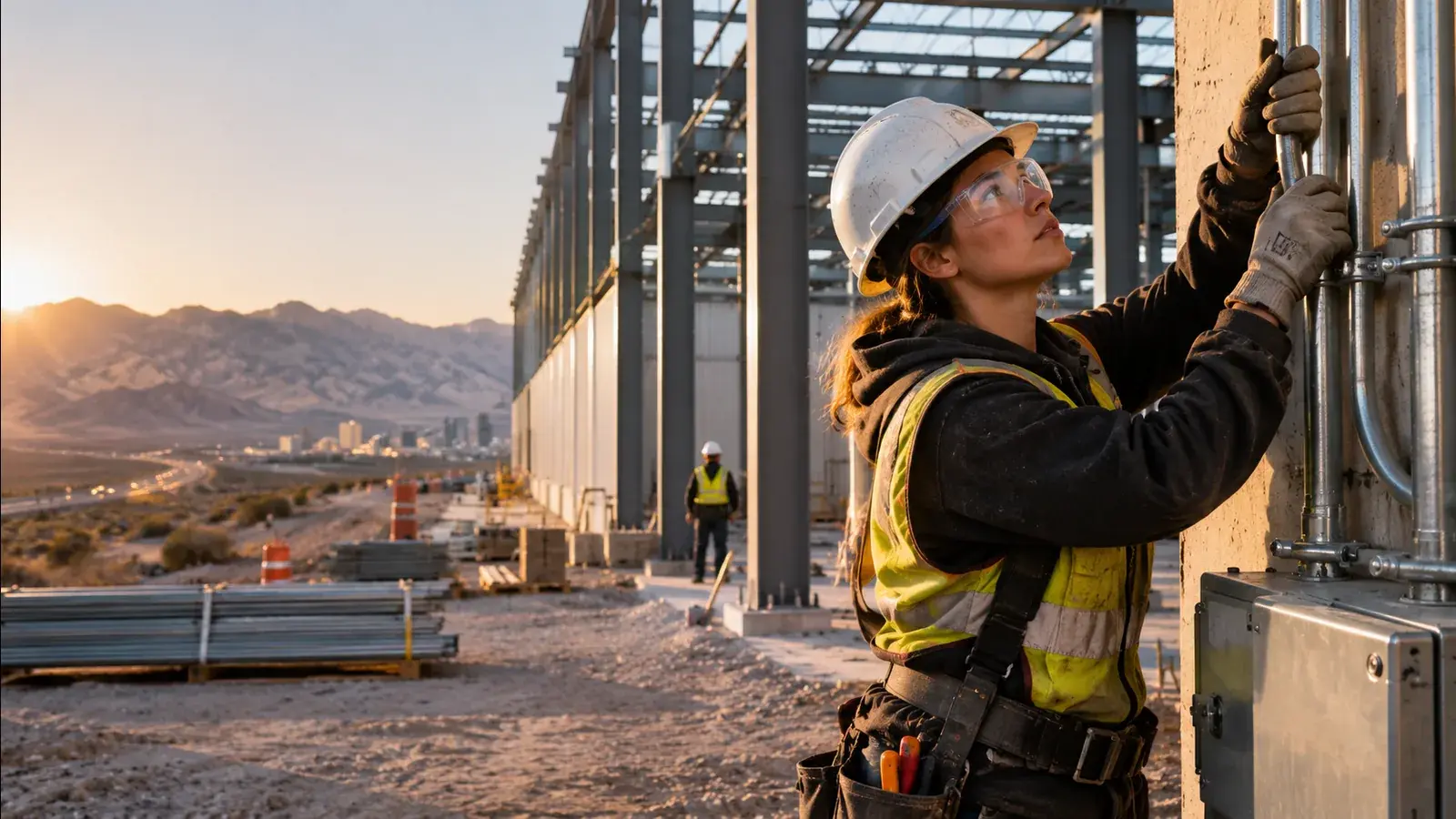
A data center going up in the desert and a hotel desk with fewer routine messages can both be described as effects of artificial intelligence. They do not offer the same person the same next job. The useful question for a regional employer is not whether AI creates more jobs than it removes in the world. It is which tasks change here, which new work actually appears, and who can enter it.
A Reuters dispatch of 28 October 2026, read on the Channel NewsAsia republication because this article did not retrieve reuters.com, puts those two scenes in Nevada. Building trades see data-center construction as work. Hospitality and transport workers are described as facing automation. The story is not a count of Nevada jobs already eliminated.1
Two official projections, and neither is "jobs created by AI"
The US Bureau of Labor Statistics handbook, last modified 27 August 2026, separates occupations that a loose phrase such as "AI infrastructure jobs" would otherwise glue together.
Electrical power-line installers and repairers held about 131,900 jobs in 2025. Employment is projected to reach 145,500 in 2035, a 10 percent change, against 3 percent for all occupations. The numeric change is 13,600. About 10,900 openings are projected each year, on average, and many of those openings are replacement needs, not new positions on top of growth. The page says increasing use of AI and the data centers that support it are expected to contribute to rising electricity demand, and that the grid will need upgrades. Housing developments and business complexes are named in the same paragraph. AI is one contributor. It is not an estimate of jobs created solely by AI.2
Electricians are a different row. About 821,000 jobs in 2025, projected employment of 896,900 in 2035, a 9 percent change and a numeric change of 75,900. About 72,700 openings a year, again mostly from growth and replacement together. The page also names AI and data centers as a contributor to electricity demand, alongside the work of linking solar and wind generation to buildings and grids. A supplied draft of this article rounded 896,900 to roughly 897,000 and placed the electrician headcount next to the line-installer growth rate. Those are not the same sentence. The two opening counts cannot be added to a local construction announcement as if they were separate, guaranteed posts.3
| Occupation | Jobs, 2025 | Projected, 2035 | Change | Openings per year |
|---|---|---|---|---|
| Electrical power-line installers and repairers | 131,900 | 145,500 | 10% (13,600) | about 10,900 |
| Electricians | 821,000 | 896,900 | 9% (75,900) | about 72,700 |
Both growth rates are "much faster than average" in the handbook's words. Average growth for all occupations is 3 percent. Neither row is a placement offer for a named hotel employee in Las Vegas.
A project expectation is not a completed hire
On 29 July 2026 the US Department of Energy said a partnership to redevelop portions of the Paducah site in Kentucky into a data-center campus, with new energy infrastructure, was expected to create approximately 8,000 construction jobs and 600 permanent jobs. The page calls the investment more than 100 billion dollars and privately funded. Brookfield was selected to develop and operate the campus. NextEra Energy was selected to build and own the dedicated energy infrastructure. The power service agreement remains subject to approval by the Kentucky Public Service Commission. Construction is expected to be completed in 2031. These are expectations. They are not observed completed hires. A large temporary construction workforce and a smaller operating workforce are different numbers, and the page already prints both.4
The inbox draft linked a staging host. The public page is on energy.gov. A NextEra newsroom release the same day also says approximately 8,000 construction jobs and 600 full-time operations jobs, and it says the campus will be fully constructed in 2032. This article uses the Department of Energy page for the job expectations and does not merge 2031 and 2032 into one completion date.5
What the Nevada dispatch actually counts
The 28 October dispatch describes more than 100,000 acres of desert east of Reno, with years of work for thousands of electricians, pipefitters and other union tradespeople. "Thousands" is the dispatch's scale. It is not a payroll audit. The Nevada Teamsters are described as a network representing 30,000 workers across construction, transportation and hospitality. Ross Kinson, the political director, is quoted: "My job is to represent all of our unions." He is also reported as urging members to ask what the boom is doing to their jobs. Some members want new data-center construction halted or slowed. Others view it as work. The dispatch was written before the 3 November 2026 election. This article does not report the result.1
The figure that travels furthest needs the verbs around it. "By 2035, AI and automation could put up to 92,000 Southern Nevada hospitality jobs at risk, or roughly one-third of that workforce, according to an analysis by RCG Economics." "Could" and "at risk" are not "will be laid off", and they are not jobs already lost. This article did not read the RCG analysis. The one-third is the dispatch's reading of that workforce, not a second study.1
Other lines in the same story should stay attributed. The opening says self-driving vehicles are replacing taxis and valets, that robot bartenders are replacing casino floor staff, and that an MGM call center is cutting hundreds of jobs. Later, Kinson says MGM Resorts laid off around 200 call-center workers "last year", which, in a 28 October 2026 story, is his timeframe rather than a filing this article has seen. MGM declined to comment and pointed Reuters to a 2023 contract with culinary union members that promised advanced notice of AI-driven job losses, plus health care and severance. The dispatch also says MGM International CFO Jonathan Halkyard said on an investor call that about 80 percent of guest interactions now take place via AI or digital platforms. This article did not read that transcript. The 200 and the 80 percent are not one audited layoff study.1
One worker's pay is not a wage series. Christopher Williams, 20, is reported as having moved from northern California after too few hours as a line cook at 18.50 dollars an hour. He now makes more than 22 dollars an hour and works 45 to 60 hours a week on the data-center cluster. That is one account in the dispatch. It does not say every hospitality worker can make the same move, or that the hours are the career they wanted.1
The International Brotherhood of Electrical Workers is reported as saying the Tahoe Reno Industrial Center generated 850,000 work hours per month in 2026, up from about the same number during all of 2022. The comparison is striking because one side is a month and the other is a year. This article did not audit the hours. It reports the claim as Reuters reports the union.1
A building-trades apprenticeship and a call-center or valet job do not share a task mix. Treating them as one labour market is how a regional jobs total hides the person who cannot cross.
A nearby vacancy is not a transition plan
Consider a hypothetical hotel employee whose employer automates routine guest messages. A data center an hour away may be hiring electrical technicians. Those roles generally require training, safety practice and sometimes a license or an apprenticeship. Geography, pay during training, transport and family obligations decide access. The scene is an illustration. It is not a documented Nevada case, and it is not a finding in the Bureau of Labor Statistics tables.
Some people will want to stay in hospitality, where guest care, events, accessibility and conflict still need a person. Others may want the technical path and need a real route: missing skills named, supervised practice, and time that is paid for. Celebrating regional job creation without asking who can enter is not a workforce strategy. The same caution applies inside one organization. A shorter task is not automatically a smaller team, a point developed in who gets the hours back when a task gets faster. The split between specialist AI work and broad familiarity is a different cut, in why the skills boom is two markets.
An OECD paper of 8 July 2026, approved by its Digital Policy Committee on 27 March 2026, is useful here only as a distinction. High-skill occupations are described as the most exposed to AI and as less likely to be automated, because they rely on non-routine cognitive and social skills. Low- and middle-skill jobs face higher automation risks, particularly where tasks are routine. In 2022-2024, around one-quarter of workers were already exposed to generative AI. Exposure is not displacement, and the one-quarter is not a Nevada headcount. The paper does not say that electricians on a data-center site will be automated. The Bureau of Labor Statistics pages say the opposite direction for that occupation's employment: growth, with AI and data centers as one reason electricity demand rises.6
What a smaller employer can measure
A small business, a social organization or a department does not need a national net-jobs model. It needs a task inventory.
Separate repeatable information work from work that depends on relationships, judgment, a physical environment or a named accountability. Test a tool on one narrow process and record errors, customer outcomes, workload and hours actually released. Then map adjacent skills. A receptionist with scheduling and conflict experience may be a candidate for guest-experience coordination. A facilities worker may already have safety habits that matter in a technical apprenticeship. Neither move is automatic.
If a tool reduces repetitive work, leaders can put the time into service quality, a new offer, shorter queues or structured learning. If the business case is a job cut, the rationale, the notice and any placement support should be said out loud. Pretending every worker will move into a trade the project happens to need is not a plan. Communities looking at a new facility can ask the same class of question the Nevada story leaves open: how long the jobs last, who is recruited from outside, what the public gives up in incentives, and what electricity, water and land the site will use. This article does not have a measured water or incentive figure for Reno or Paducah, so those stay questions rather than statistics.
How hilighter can help
hilighter does not place people into construction jobs, audit a union's hours, or predict that a hospitality role will disappear. It helps a team see the work that remains and the skills a transition would actually require.
hilighter helps teams map skills by role, compare people with those requirements in Skills & Talent Insights, record proof of capability in Skills Evidence & Recognition and set personalized growth paths. Its AI Job Impact view is indicative. It is not a hiring forecast and it is not a reading of the 92,000 figure. A free plan covers up to three job roles, with unlimited employees.
Does the 92,000 figure mean 92,000 layoffs?
No. The Reuters dispatch says AI and automation could put up to 92,000 Southern Nevada hospitality jobs at risk by 2035, or roughly one-third of that workforce, according to an analysis by RCG Economics. This article did not read that analysis. "At risk" is not a count of jobs already lost.1
Are the electrician openings jobs created by AI?
No. The handbook projects about 72,700 openings a year for electricians, from growth and from replacement. Employment is projected to rise from 821,000 in 2025 to 896,900 in 2035, a 9 percent change. AI and data centers are named as one contributor to electricity demand, not as the sole source of those openings.3
Are the Paducah jobs already filled?
The Department of Energy page says the partnership is expected to create approximately 8,000 construction jobs and 600 permanent jobs, with construction expected to be completed in 2031. That is an expectation. The power agreement still needed Kentucky Public Service Commission approval on the page read for this article. It is not a list of people hired.4
Sources
- Reuters, "Nevada unions, politicians caught between AI job creation and destruction", 28 October 2026. Read on the Channel NewsAsia republication: CNA. Data centers east of Reno; Nevada Teamsters described as representing 30,000 workers; Kinson on representing all of the unions and on asking what the boom does to jobs; up to 92,000 Southern Nevada hospitality jobs that could be at risk by 2035, roughly one-third of that workforce, according to an analysis by RCG Economics; MGM comment declined, 2023 culinary contract, Kinson on about 200 call-center layoffs "last year"; Halkyard on about 80 percent of guest interactions via AI or digital platforms, as the dispatch reports an investor call; Williams at 18.50 dollars and then more than 22 dollars; IBEW hours as Reuters reports them. The RCG analysis, the investor-call transcript and the IBEW hours were not independently read. The 3 November election result is not reported here. Quotations in the dispatch that use a contraction are paraphrased above.
- US Bureau of Labor Statistics, Occupational Outlook Handbook, Electrical Power-Line Installers and Repairers, last modified 27 August 2026. 131,900 jobs in 2025; 145,500 projected in 2035; 10 percent; numeric change 13,600; about 10,900 openings a year; average growth for all occupations 3 percent; AI and data centers named as one contributor to electricity demand, with housing and business complexes.
- US Bureau of Labor Statistics, Occupational Outlook Handbook, Electricians, last modified date read on the same handbook edition. 821,000 jobs in 2025; projected employment 896,900 in 2035; 9 percent; numeric change 75,900; about 72,700 openings a year. AI and data centers named alongside connections for solar and wind. Not "roughly 897,000", and not the 10 percent rate from the line-installer page.
- US Department of Energy, Energy Department Announces Partnership to Expand Reliable, Affordable Energy Access and Power America's AI Future in Western Kentucky, 29 July 2026. Approximately 8,000 construction jobs and 600 permanent jobs expected; more than 100 billion dollars, privately funded; Brookfield; NextEra Energy; power service agreement subject to Kentucky Public Service Commission approval; construction expected to be completed in 2031. The inbox draft linked a staging host. This citation uses the public energy.gov page.
- NextEra Energy newsroom, DOE Site in Western Kentucky Revitalized with Data Center Campus and Dedicated Energy Project, 29 July 2026. Also approximately 8,000 construction jobs and 600 full-time operations jobs. Says the campus will be fully constructed in 2032. Not merged with the Department of Energy completion year.
- OECD, Skills in the AI age (PDF), OECD Artificial Intelligence Papers No. 60, 8 July 2026. Approved and declassified by the Digital Policy Committee on 27 March 2026. Executive summary: high-skill occupations most exposed and less likely to be automated; low- and middle-skill jobs face higher automation risks where tasks are routine; around one-quarter of workers already exposed to generative AI in 2022-2024. Not a Nevada job count and not a forecast for electricians.
Sources last reviewed: 8 November 2026. The 92,000 figure is a conditional risk estimate attributed by Reuters to RCG Economics; the RCG paper was not read. Bureau of Labor Statistics openings mix growth and replacement. Paducah job counts are project expectations. The NextEra release and the Department of Energy page do not share one completion year. The OECD one-quarter is exposure, not displacement. This article is not a placement service and not legal advice. Neither an AI-detector score nor the absence of Google penalties can be guaranteed.